Separating the signal
The microphone signal can contain noise, room resonance and echoes. I worked on the noise floor, persistence and confidence to choose components to follow and reduce changes caused by uncertain detections.
Cimatica · local demo using synthetic audio. Interface in Italian
Cimatica in 33 countries
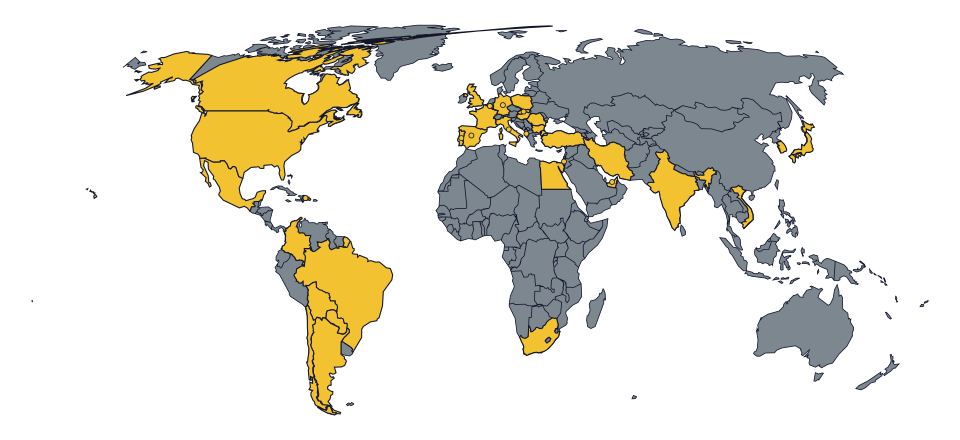
Map data: Natural Earth
I started Cimatica to explore the relationship between sound and shape. I wanted to start by analysing microphone frequencies and making them visible in the browser.
The microphone signal can contain noise, room resonance and echoes. I worked on the noise floor, persistence and confidence to choose components to follow and reduce changes caused by uncertain detections.
A pattern that changes with every fluctuation is hard to read. One that moves too slowly cannot follow changes in sound. I balanced stabilisation and transitions, letting people choose how many sound components to combine.
Working with sound taught me to assess responsiveness and readability together. A smooth transition matters when it helps someone follow a change. I use the same criterion in interfaces driven by other kinds of data.
Live product. Its patterns are mathematical visualisations driven by sound frequencies.
For the public side of Cimatica, I incorporate SEO (Search Engine Optimization), GEO (Generative Engine Optimization) and AEO (Answer Engine Optimization). Content, context and structure are part of making the product easier to find and understand.
I organise pages around people’s questions and connect answers to examples, sources and verifiable results. How I work on SEO, GEO and AEO
Tell me what you want to build or improve, who will use it and what constraints you have. I’ll get back to you so we can work out where to start.